
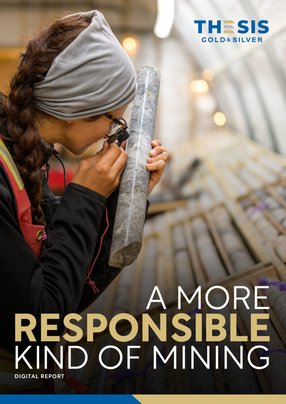
Deep in the Toodoggone district of northern British Columbia, roughly 1,000 kilometres north of Vancouver, sits one of the largest undeveloped gold and silver deposits in Canada.
The Lawyers-Ranch project – named for two distinct mineralised areas within the same claim block – is the sole asset of Thesis Gold & Silver, a Vancouver-headquartered company that has spent eight years laying the groundwork to bring it into production.
The project is, in the language of the industry, high net present value and low capital expenditure – a combination that is rarely found together and that sets Lawyers-Ranch apart from many of its peers. Thesis executives believe it could be a “company builder”.
The mining claims held by Thesis cover approximately 500 square kilometres, the majority of which remains underexplored. What has been found so far at Lawyers-Ranch is, geologically speaking, the surface expression of something potentially much larger.
Geologists believe the gold and silver deposits visible at surface level may be the upper reach of a deeper porphyry system – a type of large-scale mineral deposit typically found at greater depth, characterised by high concentrations of gold, silver and base metals like copper.
As such, the proposed development could wind up being even larger than Thesis had ever anticipated.
The man leading Thesis's sustainability charge
As is often the case in the world of mining, the team at Thesis has been established years before shovels will ever hit the earth.
Stephen Crozier joined Thesis Gold & Silver late last year to head up sustainability and external affairs. His remit spans Indigenous engagement and partnerships, government relations, environment, and permitting.
Advancing work in each of these areas will be critical to the success of Lawyers-Ranch. At the end of the day, it will determine whether the proposed project is able to proceed. More importantly, though, this work, done well, will ensure that the benefits are shared fairly and equitably.
Stephen came to the role with two decades of experience in the industry, including a long stint at IAMGOLD, where he was directly involved in advancing the Côté Gold project. More recently, he was at Wyloo, a private company developing a critical minerals project in Ontario's so-called “Ring of Fire”.
Stephen’s career took a route that few in the industry share. He moved from law into government relations and then eventually into sustainability, not by design but through successive expansions of his responsibilities, driven equally by opportunity and organisational changes. Having such a broad set of skills has made Stephen a staunch believer in the value of being a “jack of all trades”.
In fact, that kind of generalist approach to learning and working has made him the perfect person for the role he now occupies. “Law school was a tremendous experience,” he reflects. “I greatly appreciated my time there. But over time, I have also learned that one thing they don't teach you in any specialised discipline is the limits of the discipline – and the extent to which your specialised way of doing things, which works very well in certain contexts, may be suboptimal in others.”
What is open source mining?
The framework that sits beneath Thesis's work at Lawyers-Ranch is something Stephen calls “open source mining”. The term is borrowed from software development, where open source describes systems built on freely shared, publicly accessible code.
In the context of mining, it means something more radical than it might initially sound. It is, in essence, a commitment to sharing operational performance data like environmental monitoring, safety statistics and project execution metrics, with host communities, regulators and investors in real time, rather than managing what information is released and when.
“Mining is sometimes awfully good at hiding,” Stephen says bluntly. “That can include, at times, hiding even from ourselves, in terms of surfacing problems.”
Stephen and the team at Thesis want to be different. “We are going to allow permissionless flow of information – between disciplines, through all channels and all levels of the organisation,” he explains.
Stephen’s inspiration for this is the mining industry's own record on health and safety. While mining continues to have elevated health and safety risks compared to many work places, injury and fatality rates on mining sites were, by any historical measure, far worse 30 years ago than they are today.
That improvement did not come from messaging or public relations, though. Instead, it came from a fundamental change in how the industry treated data about incidents. “Industry leaders instilled a safety-first culture, made it everybody's job and stopped trying to manage the narrative,” Stephen explains.
“Instead, they decided to solely focus on managing the risk by measuring performance and capturing data. If something happens, you report it – good or bad. And when there was a miss, the industry took it seriously, answered for it, and focused on making changes to reduce the risk. We didn’t message our way out, we executed our way out.”
This was a significant achievement driven by many leaders in many companies spanning many decades. Inspired by this, Stephen wants to apply the same approach to all aspects of environmental and social performance. What’s more, he wants to do it in a way that has never been the norm. Most communities living near mining operations receive environmental monitoring data fairly infrequently, if at all. Water quality data, for instance, is something that communities ought to always know about.
If a stream which runs through both a mining site and a neighbourhood is in any way compromised by chemical runoff, people need to know about it. “We should have a scoreboard that tells us daily – maybe by the hour or by the minute – how things are going,” he says. “If we can see that data, why can't our partner communities that share the same environment?”
The resistance in the industry to sharing this kind of data openly tends to be framed around concern that communities will not understand it, or will react to it without proper context. Stephen rejects that framing.
“People are smarter and more resilient than we give them credit for,” he says. “If we share it with them, and prove to them that we're serious and that we execute and improve, we have an opportunity to drive the same kind of performance improvement that the industry delivered on health and safety while also building stronger, more trusting relationships with our host communities.”
Why health and safety is a commercial issue
The connection between health and safety and commercial performance is, for Stephen, not merely a philosophical point but an operational imperative.
Aside from being a tragedy, plain and simple, a serious accident on a construction site stops work, traumatises the workforce and costs money. Treating an injury or fatality as a line item on a risk register does not fully capture what happens at the site level in the aftermath of an incident.
“If somebody gets seriously hurt when you're building something, everything stops,” he says. “And that's just to pause for the accident. Then there's the emotional impact – what if that's your friend that got hurt? If, heaven forbid, a fatality occurs, does the team just snap right back to work after a short pause? Of course they don't.”
The link to the broader sustainability agenda is direct too. “ESG and health and safety are the same category of issues,” Stephen says. “We want to build responsible projects, which means doing the things that people welcome – jobs, investment, local development, partnership – while being transparent about managing negative externalities and ensuring that column is as small as humanly possible. But we can’t deliver on that objective through messaging. It’s not enough to talk about our commitment to doing these things. We have to prove it and, in doing so, be willing to show when we fall short.”
A new model for First Nations partnerships
The Lawyers-Ranch project sits within the traditional territories of several First Nations communities. Under Canadian law, resource developers are required to consult meaningfully with Indigenous peoples whose rights and interests may be affected by a proposed development. Thesis has been working on those relationships for eight years, well before the environmental assessment process began.
In that time, the company has signed agreements with several communities and is having discussions with others. In developing its partnership model, Thesis is drawing on the concept of two-eyed seeing – an approach increasingly applied in Canadian resource development that involves integrating Indigenous knowledge systems alongside Western scientific perspectives when assessing the implications of proposed projects.
Shared economic participation will also be a cornerstone of the Company’s approach to project development. For Stephen, the development model where a company rolls in, builds a mine and imports the majority of its workforce and supply chain from elsewhere is simply no longer viable.
“That approach exports the bulk of the economic activity outside the region,” he says. “That's not an attractive model for local communities, and it's not a sustainable model.”
Thesis's intention is to involve host communities in the physical delivery of the project where possible. The mine will require a camp, an airstrip, a processing mill and various other infrastructure. Stephen hopes that the local communities will get involved with this work. “If we do this well, it can help foster really deep economic participation for the Nations on this project,” he says, “and that is exactly what we're going to try to do.”
The open source mining philosophy feeds into these partnerships too. The goal is to give host communities access to the same performance data that management and investors use to track the project. "We want to advance on our proposed project in as open and transparent a manner as possible," Stephen says. "The core of what that openness and transparency is intended to yield is accountability."
The role of Tidalco in Thesis’ project
One of the most important relationships Thesis has built in developing its operating model is with a company called Tidalco, a consultancy that specialises in integrated, systems-level thinking for complex projects.
Conventional corporate structures tend to divide work into functional silos, whether that’s groups of engineers, environmental analysts, community relations officers or financiers. Often, each division is working in isolation. Tidalco’s mission is to help organisations build the connective tissue between teams.
Stephen uses a pointed analogy to explain the problem the company helps to solve. “Many organisations will turn to the organogram first when an issue comes up – it's like: ‘We have a problem in the environment, so we'll hire a VP of Environment. Problem solved.’ No – problem not solved. Because resolving the problem requires effective collaboration between the VP and their staff with people in other functions. It’s that connective tissue that requires equal attention.”
Tidalco has been working with Thesis to this end, translating its values and stated mission into a slick operating model – one in which what the company says it stands for is directly and demonstrably reflected in how it works.
“They're a small shop,” Stephen says, “but they do this work very well – helping companies and stakeholders build that integrated, systems-level way of thinking.”
The road to construction
The environmental assessment for the Lawyers-Ranch project was formally initiated in December 2025. In Canada, such assessments for major mining projects are lengthy, multi-year processes with many a milestone to be reached. Thesis expects to submit a detailed project description – one of the earliest formal stages in the process – in Q3 2026, while the full assessment is expected to run through 2027 and into 2028.
Running in parallel, the company is also advancing towards a full feasibility study. A feasibility study is the definitive technical and financial document required before a construction decision can be taken, providing a detailed estimate of engineering design, project costs and expected returns. The feasibility study is expected to commence later in 2026, with a target completion date at the end of 2027.
All being well, Thesis is aiming to begin construction in 2029. “Some would say that's optimistic or aggressive,” Stephen acknowledges. “And in a way that’s true, but it's also achievable. So we are going to be targeting that timeline.”
But Stephen’s ambition is not only to break ground on time. Instead, it is to arrive at that moment genuinely prepared, with community partnerships in place, the environmental management plans tried, tested and iterated and the organisation aligned around a shared way of working.
“Our goal is to advance quickly,” he says, “but through each of these areas, make sure that we're advancing at depth, so that when we arrive, we're ready. Not just ready to get a permit and get a shovel in the ground, but ready in the broadest, deepest sense of what ready can mean.”
Company portals

Executives

Stephen Crozier
EVP of External Affairs & Sustainability