

Thesis Gold & Silver's ‘Open Source’ Vision for Mining

Thesis Gold & Silver's ‘Open Source’ Vision for Mining
Deep in the Toodoggone district of northern British Columbia, roughly 1,000 kilometres north of Vancouver, sits one of the largest undeveloped gold and silver deposits in Canada. The Lawyers-Ranch project – named for two distinct mineralised areas within the same claim block – is the sole asset of Thesis Gold & Silver, a Vancouver-headquartered company that has spent eight years laying the groundwork to bring it into production.
With an estimated mine life of 14-20 years, Thesis executives believe the project could be a "company builder". The project sits within Thesis’ claims block which covers about 500 square kilometres, the majority of which remains underexplored. What has been found so far is, geologically speaking, the surface expression of something potentially much larger – geologists believe the visible deposits may be the upper reach of a deeper porphyry system, characterised by high concentrations of gold, silver and base metals like copper.
Stephen Crozier joined Thesis late last year to head up sustainability and outreach, a remit spanning Indigenous engagement, government relations, environment and permitting. He came to the role with two decades of experience, including a long stint at IAMGOLD and more recently at Wyloo, a private company developing a critical minerals project in Ontario's Ring of Fire. His route into the role was unconventional – from law into corporate affairs and eventually sustainability – and it has made him a firm believer in the value of the generalist. "Going to law school was a wonderful experience," he reflects. "But one of the things they don't teach you is the limits of your own discipline."
The framework underpinning Thesis's approach is what Stephen calls "open source mining" – a commitment to sharing operational data, environmental monitoring and project metrics with host communities, regulators and investors in real time. "Mining is sometimes awfully good at hiding," he says bluntly. "That can include hiding from ourselves, in terms of surfacing problems."
His inspiration for a new approach is drawn from the industry's own record on improving health and safety performance. Injury and fatality rates on mining sites are, by historical measure, far better today than they were 30 years ago – and that improvement came not from messaging but from a fundamental change in how incident data was treated. "We manage the data, we manage the risk," he says. "We didn't message our way out – we executed out." He wants to apply the same approach to environmental and social performance: real-time data, shared openly with communities who live alongside the project.
The Lawyers-Ranch project sits within the traditional territories of several First Nations communities. Thesis has been building those relationships for eight years, drawing on the concept of two-eyed seeing – integrating Indigenous knowledge alongside Western scientific perspectives. Crucially, the company wants host communities involved in the physical delivery of the project, from the camp and airstrip to the processing mill. "If we do this well, it can help foster really deep economic participation by the Nations on our project," Stephen says. "That is exactly what we're going to try to do."
Supporting this work is Tidalco, a consultancy specialising in integrated, systems-level thinking – helping Thesis break down the functional silos that plague conventional corporate structures and ensuring that what the company says it stands for is reflected in how it actually works.
The environmental assessment was formally initiated in December 2025, with a full feasibility study expected to commence later in 2026. Construction is targeted for 2029. "Some would say that's optimistic," Stephen acknowledges. "That's true, but it's also achievable."
His deeper ambition, though, is not only to break ground on time but to arrive genuinely prepared – partnerships in place, environmental management tested and iterated, and the organisation aligned. "Not just ready to get a permit and get a shovel in the ground," he says, "but ready in the broadest, deepest sense of what ready can mean.”
Company portals

Executives
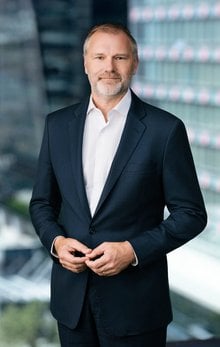
Stephen Crozier
EVP of External Affairs & Sustainability