
Domestic Metals Mining: Behind the UK's First Lithium Plant
Following supply chain risks across critical minerals in 2025 and the growing demand for substances like lithium, the UK is looking to secure its own supplies.
Lithium mining has been driven by the recent soar in demand for electric vehicle (EV) batteries, with extraction mainly occurring across Australia, Chile, Argentina and Bolivia.
Now though, the UK is looking to begin its own lithium mining operations, positioning itself within the global lithium supply chain.

The diversification need
Electrification is a key strategy in energy emissions reduction, allowing renewable energy sources to substitute liquid and gaseous fuels. With the growing sales of EVs and the global phase-out of petrol and diesel, the demand for lithium-ion batteries is increasing. This demand, however, is putting significant strain on lithium supplies around the world, with concerns about capacity to meet extraction and refining needs.
Lithium is a critical material for lithium-ion batteries and by 2024, the global requirement for EV batteries had crossed 950 GWh. Now, more than 90% of lithium is associated with battery production. Predictions from the World Economic Forum (WEF) suggest yearly lithium demand will reach three million tonnes by 2030.
Current production is dominated by mining companies in Australia, while reserves predominantly exist in the 'Lithium Triangle' of Chile, Argentina and Bolivia. However, positioning these countries as the main providers comes with major risks, as supply and demand concerns are high, as are vulnerability from weather shocks and water scarcity.
As a result, more mines across Australia are re-opening or expanding their capacity, but there is also a growing number of investments in mines on the other side of the world. Now, the UK has started operations on its first-ever commercial scale lithium plant.
UK mining
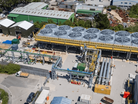
Geothermal Engineering Ltd’s (GEL) facility in Redruth, Cornwall is the UK's first step to securing its own supplies of the critical mineral. It will begin operations by production 100 tonnes of lithium every year, which will power approximately 2,000 electric vehicles.
As its standing grows, the mine will increase its capacity, with plans to grow to producing 1,500 tonnes in a few years, before reaching more than 18,000 annual tonnes across the upcoming decade. This scale-up will require approximately £640m (US$874.6m).
GEL plans to extract lithium from mineral-rich liquids underground and is among a handful of UK lithium hopefuls looking to become the first to bring their projects online. As western countries look to secure domestic supplies of critical minerals, GEL is doing what it can to be number one. It has recently made the UK's first geothermal power plant live, which will help supply the lithium operation.
Ryan Law, founder of GEL, notes that the geothermal power plant will help reduce the cost of lithium production, helping it produce the critical material cost-effectively.
“We can easily compete with what’s coming from China,” he said.
As well as the rising demand for EV supply, western mines are also eager to solidify their own operations due to earlier trade concerns. In 2025, China weaponised its control over rare earths by limiting exports. According to Project Blue, Beijing dominates the processes of lithium, having controlled approximately 60% of global production in 2025. It also has significant influence over the supply chains that turn the metal into batteries, causing further tensions.
The UK government has a target of domestically producing 50,000 tonnes of lithium by 2035. Though western lithium projects had been approved of in 2021, a crash led to many being renegotiated, cancelled or delayed, putting western efforts behind.
All sustainability, net zero and sustainable procurement leaders should attend:
- Procurement & Supply Chain LIVE: The Net Zero Summit - QEII Centre, London, March 4-5
- Procurement & Supply Chain LIVE: The US Summit - Navy Pier, Chicago, April 21-22
Co-located with Sustainability LIVE, these events brings together CPOs, CSCO, CSOs, ESG leaders and senior decision-makers at a moment when sustainability, supply chains and commercial performance are increasingly interconnected.
Tickets can be booked online today for The Net Zero Summit and The US Summit. Group discounts available.
Further diversification
Other European mining companies have been pushing forward with their plans. Cornish Lithium's demonstration plant has been producing samples of battery grade lithium hydroxide for customers to test since October. Following the success, it hopes to open its commercial plant by 2029, relying on raising funds to ensure it can open.
British refiner Green Lithium still hopes it will have an operational demonstration plant by next year, having had to push back the opening of its commercial plant from 2024 to 2029.
Currently, there is no certainty that UK and European lithium will be cost-competitive with China, with car-makers unlikely to pay more for material just because it is sourced more locally. Though lithium is a small – but vital – part of the overall cost of an EV, these prices need to be considered before supply chains can be formed, including whether it is the carmaker or the consumer who absorbs higher costs.
Although Europe is demonstrating mining capabilities, it also has a lack of cathode active material (CAM) manufacturing. This process converts lithium into material that battery manufacturers can use. As most of this capacity in China, European manufacturers are limited with their production.
European lithium producers will still rely on Asian supply chains to meet demand, showing a potential for disruption and an inability to act independently. At present, GEL's lithium carbonate will be processed at LevertonHELM in Basingstoke, to be processed into battery-grade material before the CAM manufacturing step.
Though there are still questions about the final result, this dedication to domestic mining is a huge step in securing local critical minerals supply chains.
Company portals


Executives
Ryan Law
CEO