
How are Robotics Transforming the Mining Industry?
Robotics in mining is becoming more common all the time, with businesses utilising technology to increase efficiency and safety across operations.
Ongoing skills gaps and increases in demand mean that the human workforce is no longer enough – instead, leaders are turning to robots and autonomous equipment to transform the mining industry.
Much of the advancements are in place to enhance safety across each site, reducing how much risk human workers are exposed to.

Enhancing safety
The mining industry is seen as inherently hazardous and labour intensive. As a result, ensuring is taken care of at every step is a main priority. This often relies on proactive risk management such as training and strict PPE, but it has also recently been expanding to technological advancements.
Now, automation and robotics are becoming a central role to modern mining operations, putting the mining industry through a transformative phase. Mining companies around the world are integrating remote-controlled machinery, autonomous equipment and robotic systems throughout the company in order to enhance safety, reduce risk to hazardous environments and increase operational efficiency.
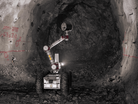
Chilean copper miner Codelco’s El Teniente Division is utilising the Arkytas MU-2.1 robot by Kinamics in its search for a zero-exposure mine. It is currently in use across the Esmerelda mine, in sectors which have not been reinforced with ground support and therefore human entry is prohibited. Rather than having to wait for this to occur, the team is using the robot to capture images in order to digitally recreate the area.
As well as protecting the safety of the workers, this operation also increases the efficiency of the project. Instead of having to wait for sites to be cleared and secured, pushing the timeline of each project back, staff can remain working at all times.
According to Javier Valenzuela, an Engineer with the Innovation Unit of the El Teniente Division, the robot was introduced to operations “because of how risky it is to enter the front. After a blast, the area had to be isolated for a long time, so the aim was to reduce the exposure of workers to these risks.”
The process, photogrammetry, will be transforming 22 photos into 3D models in order to give an accurate image of the site. However, the robot also allows other information to be extracted, including humidity, granulometry and dilution. It is helping Codelco to analyse the site, using high quality data while eliminating risk.
All sustainability, net zero and sustainable procurement leaders should attend:
- Procurement & Supply Chain LIVE: The Net Zero Summit - QEII Centre, London, March 4-5
- Procurement & Supply Chain LIVE: The US Summit - Navy Pier, Chicago, April 21-22
Co-located with Sustainability LIVE, these events brings together CPOs, CSCO, CSOs, ESG leaders and senior decision-makers at a moment when sustainability, supply chains and commercial performance are increasingly interconnected.
Tickets can be booked online today for The Net Zero Summit and The US Summit. Group discounts available.
Changing markets
Persistence Market Research estimates that the global mining robotics market size will be valued at US$1.7bn in 2026, reaching US$3.3bn by 2033. This is due to the rising demand for automation in hazardous mining environments, as well as persistent labour shortages and the need to increase operational efficiency across the sector.
Within the overarching growth, it is anticipated that the autonomous haulage systems segment will lead, as a result of widespread adoption in large-scale open-pit mines. Most of the adoption is anticipated to be within North America, as that area saw early adoption of automation technologies, heavy investments in digital mining transformation and advanced mining infrastructure.

The mining robotics market includes:
- autonomous haulage systems
- robotic drilling equipment
- underground robotic loaders
- robotic crushers
- inspection and surveillance robots
- teleoperated mining vehicles
Inspection robots are being increasingly adopted as companies focus on risk assessment and predictive maintenance in deep mining shafts, whereas robotic drilling systems are used for precision and safety in underground operations.
The Reward Gold Mine site in Australia is deploying the Aramine L350D autonomous mining loader, which is equipped with Epiroc's AutoNav Tele software from RTC. It is designed for narrow-vein mining, allowing for the increased efficiency in mining operations.
“This is more than just a machine installation,” said Owen Perrott, RCT’s East Coast branch manager.
“We’re introducing technology that can access areas previously unreachable, in this narrow-vein mine, unlocking gold reserves left behind for decades.”
It allows remote operators to control the loader from a safe location, providing them access to tight areas without putting them at risk.
In early 2026, NVIDIA and Caterpillar expanded their partnership to bring physical AI capabilities to mining operations. This was in place to optimise extraction processes and enable autonomous machinery across sites around the world.
Through ongoing robotics innovations, the mining industry is becoming increasingly more safe and more efficient. This is particularly needed now, when the mining industry is seeing more demand due to the use of critical materials. By increasing the use of automation and robotics, the mining sector will be able to reduce project time, operate longer hours and access more areas than ever before.
As a result, the mining robotics market is seeing a major boom.
Company portals
Caterpillar Inc.
Codelco
Epiroc
NVIDIA