
Australia & Japan: A New Critical Minerals Partnership
Critical minerals supply chains have been a core topic of discussion in recent years, as they become more sought-after and the need to diversify becomes heightened.
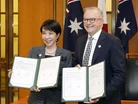
Amid a state visit, Australia and Japan have signed a series of agreements on critical minerals, energy and food supply chains.
This agreement will help protect both economies and will strengthen relationships between the nations.

Developing resilience
Amid a three-day visit to Australia, Japan's Prime Minister Sanae Takaichi met with Australian Prime Minister Anthony Albanese to discuss new trade agreements.
In recent years, critical minerals have become a core commodity, driven by the use of AI, the integration of electric vehicles and the ongoing energy transition. Demand for materials such as lithium, copper and nickel is increasing every day. Despite this, critical minerals and rare earth supply has been dominated by China, with the country controlling 70% of global refining capacity for 19 out of 20 critical minerals.
Now though, countries around the world are forming new partnerships in order to develop a critical minerals supply chain which does not depend on China.
As a result, Japan and Australia have formed a new partnership, working to develop supply chain resilience across a range of sectors. Currently, Australia provides approximately 33% of Japan's energy supply, as well as being its largest market for liquified natural gas. As tensions in the Middle East have had countries looking to stabilise their energy supply chains, Japanese firms have increasingly been following Australian LNG developments.
"Australia and Japan are taking action to protect our economies from future economic shocks and uncertainty," Prime Minister Albanese said in a statement.
"By working together, we will achieve more secure and resilient supply chains that will benefit Australian and Japanese businesses and consumers now and into the future."
Ongoing partnerships
Australia plans to provide up to AU$1.3bn (US$943m) to the partnership, whereas Japan has already provided AU$370m (US$268.5m) in grants and investments, with plans to increase this as projects develop.
This follows a growing partnership between Sojitz and Japan Organisation for Metals and Energy Security, which provided financing to Lynas Rare Earths in 2011. This helped it commence light rare earth production. By 2025, this had grown into heavy rare earth production.
Sojitz and JOGMEC have also worked with one of Alcoa's operating alumina refineries in Western Australia, in order to develop gallium recovery for use in LEDs, solar cells and semiconductors.
Following the official agreement between the two governments, there will be further collaboration with a strong diversification of critical minerals supply chains and a strengthened energy sector.
"Our joint statement on energy security reaffirms our commitment to navigate the current energy crisis together and maintain open trade flows of essential energy goods, including liquid fuels and gas," explains Prime Minister Albanese.
"Our joint statement on critical minerals elevates critical minerals to a core pillar of our economic and security relationship, driving Japanese and Australian co-investment in trusted Australian critical mineral supply chains.
"Our enhanced defense and security cooperation will further develop our already advanced defense relationship so we can do more together to support regional peace and security."
The countries are working together for a comprehensive and collaborative supply chain across energy, critical minerals, food and other manufactured goods.
The joint statement affirms that the partnership will work towards supply chain resilience, as well as the energy transition and work on renewable energy resources. Australia's reserves of critical minerals will be an important part of this transition, as it will help both countries undergo strategic benefits.
Moreover, there will domestic smelting and metal processing in order to strengthen the economies and industrial resilience. Throughout the partnership, the Prime Ministers stress that this will be a collaborative and transparent agreement.
"We affirmed that Japan and Australia will closely communicate with each other in responding with a sense of urgency," explained Prime Minister Takaichi.
As a result of this agreement, both countries are able to reduce reliance on Chinese critical minerals production, enabling the nations to form new partnerships with strong resilience and authority over their own supply chains.