How is Holcim's Mining Operations Supporting Sustainability?
Swiss construction materials company Holcim has released its 2025 sustainability results, revealing how its extensive quarrying operations are being managed alongside its decarbonisation targets.
Operating 408 quarries across 43 global markets, the company specialises in cement, ready-mix concrete and sustainable building solutions.
The company's Full Year Results and Sustainability Statement for 2025 demonstrate how mining activities are being balanced with environmental restoration and resource management as part of its NextGen Growth 2030 strategy.

Quarrying operations and restoration
Holcim's raw material extraction operations disturbed 19,673 hectares of land during 2025 across its 408 quarries. The company rehabilitated 7,658 hectares by year-end, with 100% of quarries having a rehabilitation plan in place.
Of the 252 quarries identified as having high biodiversity importance, 98% have implemented specific Biodiversity Management Plans (BMPs). The company spent US$1.1m on biodiversity offsets in 2025 to address the environmental impact of its extractive operations.
The mining operations serve as the primary source of raw materials for Holcim's cement and concrete production. During 2025, ECOPact made up 31% of ready-mix concrete net sales, while ECOPlanet represented a 36% share of cement net sales.
The company aims to increase both products to more than 50% of their respective category sales. This expansion of sustainable product offerings forms a key component of the company's strategy to align extraction activities with environmental commitments.
Water management at extraction sites
Mining operations are a primary consumer of freshwater in Holcim's business. The company has set a goal to reduce specific freshwater withdrawal in aggregates by more than 50% by 2030 compared to a 2020 baseline.
As of 2025, this goal was achieved, reaching 102 litres per tonne. To mitigate the impact of extraction, 76% of sites in water-risk areas are equipped with water recycling systems.
Kim Fausing, Chairman of the Board at Holcim, says: "2025 was a transformative year for Holcim, as we began to deliver on our NextGen Growth 2030 strategy as the leading partner for sustainable construction.
"I am honoured to be part of a winning team in my first year as Chairman of Holcim, and I thank all of our employees for their dedication in delivering these great results."
The water management systems at extraction sites represent a critical element of the company's operational sustainability framework. These initiatives support broader resource efficiency targets across the mining portfolio.
Responsible sourcing and supply chain
Holcim recognises the environmental and social risks inherent in third-party extraction and has implemented a Responsible Mining Programme. The company engages with key extractive material suppliers through on-site assessments and development programmes.
The company verified that it did not process or place in free circulation any conflict minerals (tantalum, tin, tungsten or gold) from high-risk areas in 2025. Holcim maintains a zero-tolerance policy for "land grabbing" and requires the application of free, prior and informed consent (FPIC) for Indigenous peoples in all mining projects.
Miljan Gutovic, CEO of Holcim, says: "The absolute highlight was the launch of our NextGen Growth 2030 strategy to be the leading partner for sustainable construction. We accelerated initiatives for decarbonisation and circular construction through ECOCycle, while building a nature-positive future."
Holcim aims to accelerate growth in circular construction through increasing its construction demolition materials (CDM) volumes using its ECOCycle technology, with a target of reaching more than 20 million tons of CDM by 2030. This technology could help reduce demand for primary raw materials extracted from quarries by guaranteeing between 10% and 100% of recycled CDM in the construction process.
Carmen Diaz, Chief People and Sustainability Officer at Holcim, says: "We are accelerating the scale-up of our sustainable offering – from ECOPact and ECOPlanet to ECOCycle – across all of our markets. Our strong 2025 results are a clear reflection of how the Holcim Spirit is motivating us to deliver value for our people, customers and shareholders as the leading partner for sustainable construction."
Company portals
Executives
Carmen Díaz Canabal
Chief People and Sustainability Officer
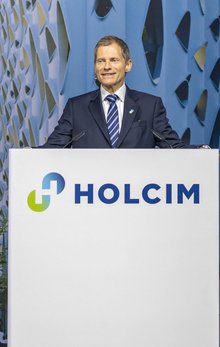
Kim Fausing
Chairman of the Board
Miljan Gutovic
Chief Executive Officer