
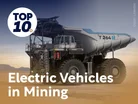
Mining has traditionally run on diesel, but that is changing fast. Battery and electric-drive machines are now being trialled and deployed at some of the world's largest mines, driven by emissions targets, rising fuel costs and the operational benefits of removing diesel exhaust from underground environments.
The technology spans the full range of mining equipment, from underground loaders and haulers to the largest surface haul trucks and excavators.
Manufacturers across the US, Europe and China are all racing to bring viable electric machines to market at scale.
Every battery-electric loader, hauler or truck added to a mine's fleet adds to the same lithium demand that's squeezing supply chains, with the mining sector now facing pressure to extract more minerals over the coming decades than it has across its entire history.
Here, we rank ten of the leading electric vehicles reshaping mining today.
10. Volvo CE A40 Electric
Company: Volvo Construction Equipment
President: Melker Jernberg
HQ: Gothenburg, Sweden
Volvo CE's A40 Electric is a battery-electric articulated hauler with a 39-tonne payload.
In April 2026, Volvo CE began serial production of the A40 Electric alongside the smaller 29-tonne A30 Electric at its Braås site in Sweden, becoming the first manufacturer to bring electric haulers of this size class into series production.
Offering up to six hours of runtime per charge, the machines target the high-utilisation duty cycles typical of quarrying and mining. First deliveries go to UK and Norwegian customers.
9. Sandvik Toro LH514iE
Company: Sandvik
CEO: Stefan Widing
HQ: Stockholm, Sweden
Sandvik's Toro LH514iE is a cable-electric loader built for underground hard rock mining, with a tramming capacity of 14 tonnes.
It runs on Sandvik's Intelligent Control System and is AutoMine-ready, supporting both manual and automated operation depending on site requirements.
Cable-electric machines like the LH514iE remove diesel exhaust from underground environments entirely, cutting the ventilation infrastructure a mine needs to run. Unlike battery-electric equipment, cable-electric loaders avoid charging downtime altogether, running continuously so long as they remain connected to the mine's power supply.
8. Epiroc Scooptram ST18 SG
Company: Epiroc
CEO: Helena Hedblom
HQ: Stockholm, Sweden

Epiroc's Scooptram ST18 SG is a battery-electric underground loader with an 18-tonne payload capacity, part of the company's Smart and Green (SG) series combining battery-electric drive with Epiroc's Rig Control System.
It uses a second-generation battery-electric drivetrain, proven in the field by its smaller sibling, the Scooptram ST14 SG.
The loader carries a 540 kWh nominal battery, among the highest energy densities in its class, and offers up to 50% higher installed battery capacity than competing loaders, according to Epiroc, reducing the number of stops needed for charging or battery swapping.
7. Epiroc Minetruck MT42 SG
Company: Epiroc
CEO: Helena Hedblom
HQ: Stockholm, Sweden
Epiroc's Minetruck MT42 SG is a battery-electric underground haul truck with a 42-tonne payload capacity, currently the largest battery-powered Minetruck in Epiroc's range.
Also part of the company's Smart and Green (SG) series, it pairs a fully electric drivetrain with strong acceleration on inclines, cutting dump cycle times compared with diesel equivalents of similar capacity.
Epiroc has separately unveiled the Minetruck MT66 S eDrive, a diesel-electric hybrid haul truck developed with Gold Fields Australia and shown at MINExpo in September 2024.
Rather than running on batteries, it combines an upgraded diesel engine with a new-generation electric drivetrain, reaching up to 11% higher ramp speed than earlier models and cutting fuel consumption by as much as 7%.
6. Sandvik Toro LH518iB
Company: Sandvik
CEO: Stefan Widing
HQ: Stockholm, Sweden

Sandvik's Toro LH518iB is an 18-tonne battery-electric loader, delivering 540 kW of electric drivetrain power and 6,000 Nm of torque.
Freed from the ventilation limitations that constrain diesel machines underground, it can run more powerful motors than a combustion equivalent would allow.
The loader uses Sandvik's AutoSwap system, letting operators change batteries in around three minutes without leaving the cabin. Sandvik also offers Battery as a Service, retaining ownership of batteries and chargers itself so customers can avoid the large upfront infrastructure costs of electrification.
5. Liebherr R 9400 E
Company: Liebherr
President: Jan Liebherr
HQ: Bulle, Switzerland
The Liebherr R 9400 E is an electric-drive mining excavator, converted from a diesel machine originally supplied in 2010. The retrofit marked Liebherr Mining's first repower of a diesel-drive machine to electric, and the first Liebherr electric excavator to operate in Australia.
Around 60% of the electric-powered excavator's components are unchanged from its diesel-driven counterpart, simplifying the repowering process for Liebherr's engineers.
Fortescue has since developed a hydrogen-powered version of the same machine's power unit, with battery and fuel cell sizing tailored to suit different site duty cycles.
4. Komatsu PC9000-12
Company: Komatsu
CEO: Takuya Imayoshi
HQ: Tokyo, Japan
The Komatsu PC9000-12 is the largest hydraulic excavator in the company's history, capable of moving 80 tonnes of material per pass at a rate of more than 8,000 tonnes an hour.
It runs on electric-drive technology, powered via a grid connection rather than an onboard battery.
Komatsu has separately committed to developing hybrid haul trucks alongside engine partner Cummins, part of a wider roadmap of power technology solutions the two companies say is aimed at progressive decarbonisation across Komatsu's large mining truck range, extending beyond the excavator business.
3. XCMG ZNK95
Company: XCMG
Chairman: Yang Dongsheng
HQ: Xuzhou, China
The XCMG ZNK95 is an 85-tonne autonomous battery-electric haul truck, built without a cab and equipped with a 509 kWh battery pack that can be swapped on site rather than charged. It operates using Huawei's 5G-based autonomous haulage system, and is designed to run in temperatures as low as -40°C.
In May 2025, 100 ZNK95 trucks entered operation at the Huaneng Yimin open-pit coal mine in Inner Mongolia, forming what XCMG describes as the world's first 100-strong autonomous, battery-electric mining truck fleet.
XCMG Chairman Yang Dongsheng called the project "a convergence of energy, technological, equipment, and commercial revolutions," adding that it delivers "a world-class blueprint for global green, intelligent mining."
XCMG has since signed a deal to supply up to 200 of its 240-tonne battery-electric haul trucks to Fortescue, marking its largest expansion beyond China to date.
2. Caterpillar Cat 793 XE (Early Learner)
Company: Caterpillar
CEO: Joe Creed
HQ: Irving, Texas, US
The Cat 793 XE Early Learner is Caterpillar's next-generation battery-electric haul truck, carrying a 240-tonne payload.
The first units were built and tested at Caterpillar's Tucson Proving Ground in Arizona before deployment to customer sites including Newmont's Cripple Creek and Victor mine in Colorado and Vale's operations in Brazil.
In June 2026, BHP, Rio Tinto and Caterpillar launched an industry-first trial of two 793 XE trucks at BHP's Jimblebar iron ore mine in Western Australia's Pilbara, following extensive safety validation testing in the US.
The trial forms part of a wider industry effort to lower greenhouse gas emissions across large-scale mining operations, with seven Early Learner trucks currently being tested and validated at customer sites globally as Caterpillar builds toward commercial-scale production.
1. Liebherr T 264 Battery Electric
Company: Liebherr
President: Jan Liebherr
HQ: Bulle, Switzerland
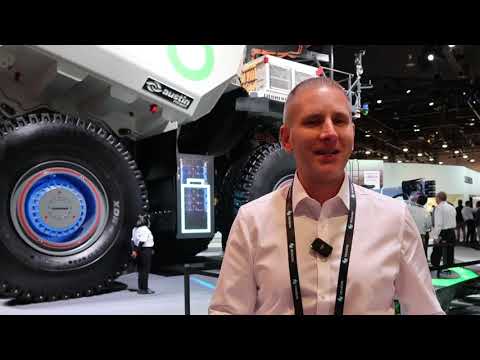
The Liebherr T 264 Battery Electric is a 240-tonne class mining truck, built on the base of Liebherr's proven diesel-electric T 264 platform and designed to produce zero greenhouse gas emissions during operation.
It supports a range of static and dynamic charging options, including trolley assist and Liebherr's Power Rail system, and can be operated autonomously through Liebherr's Autonomous Haulage Solution.
The truck anchors Liebherr's partnership with Fortescue, the largest equipment deal in Liebherr's 75-year history, covering 475 electric mining machines including 360 autonomous, battery-powered T 264 trucks.
Fortescue says a fleet of T 264 Battery Electric trucks can reduce energy cost per tonne by 86%, with the truck running on a 3.2 MWh battery developed in-house by Fortescue Zero, the company's technology arm.
Company portals











Executives

Helena Hedblom
CEO and President

Jan Liebherr
President
Joe Creed
Chief Executive Officer

Melker Jernberg
President
Stefan Widing
President and CEO

Takuya Imayoshi
CEO

Yang Dongsheng
Chairman