
Top 10: Autonomous Mining Vehicles
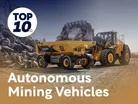
Mining vehicles have traditionally relied on diesel engines and human interaction, but companies are now turning to a more autonomous process.
According to OECD data, productivity in manufacturing industries doubled between 1997 and 2023, while mining saw a 50% decrease.
The equipment covers a range of mining operations, from rock mass transportation to navigation systems.
Mining Digital has ranked the top autonomous mining vehicles.
10. KAMAZ-6559 Jupiter 30
CEO: Sergey Kogogin
Headquarters: Tatarstan, Russia
In September 2023, KAMAZ announced its pilot operation of the Jupiter 30, deploying the vehicle in the Kemerovo region’s coal mines.
The vehicle is a 30-tonne cabless and autonomous mining dump truck that operates without human involvement.
It is designed to transport loosened rock mass and ore, removing people from dangerous areas within a quarry.
Jupiter 30 has 2D and 3D LiDAR radar units and ultrasonic sensors, alongside an integrated GPS/GLONASS satellite positioning system.
9. Sandvik Toro LH514E
CEO: Stefan Widing
Headquarters: Stockholm, Sweden
The Sandvik Toro LH514E is a 14-tonne cable-electric underground loader that holds AutoMine readiness.
It is used for underground rock mining and operates both autonomously, and manually to meet different site requirements.
The vehicle has onboard diagnostics, real-time tracking and automated steering sensors that work through slim underground tunnels.
Sandvik says customers have “flexibility to upgrade from manual to autonomous operations at any time in the equipment’s lifespan”.
8. Scania Autonomous Heavy Tipper
CEO: Christian Levin
Headquarters: Södertälje, Sweden

Scania opened orders for its 40-metric tonne autonomous heavy tipper in May 2024.
The vehicle is monitored and manoeuvred by an intelligent control system that uses cameras, radars, LiDAR and GPS receivers.
Its self-driving feature allows full integration into active mine sites, aiming to boost productivity and lower-emission hauling than traditional haulers.
Scania’s vehicles are predominantly used by Rio Tinto at the Dampier salt operation in Western Australia.
7. Epiroc Pit Viper 271
CEO: Helena Hedblom
Headquarters: Stockholm, Sweden
The Epiroc Pit Viper 271 is described by the company as “the drill that put the Pit Viper series on the map”.
Operating on a variety of surfaces including gold, coal, copper, iron ore, silver and phosphate, the equipment drills single-pass holes up to 18m.
It has a patented cable feed system with automatic tensioning, which can lower costs and improve component life.
Onboard automation capabilities are provided through its Rig Control System, offering autonomous drilling with minimal human interaction.
6. Volvo TA15
CEO: Martin Lundstedt
Headquarters: Gothenburg, Sweden
Volvo’s TA15 model is part of the company’s TARA autonomous transport solution.
It is used to transport material in repetitive flows in contained off-road areas and works alongside loading equipment.
The vehicle uses a 150kW high-power charger and the overall charging process is fully autonomous.
Volvo says the TA15’s primary benefits are “increased energy, lower emissions, increased safety and an overall increase in process productivity”.
5. XCMG ZNK95
CEO: Yang Dongsheng
Headquarters: Jiangsu Province, China

The XCMG ZNK95 is an 85-tonne mining dump truck that operates through a fully autonomous platform.
Huawei's 5G advanced network manages the vehicle and allows it to work 24/7 without any human involvement.
It is used to haul heavy earth and coal in extremely cold conditions, maintaining operations in temperatures down to -40C.
Through its autonomous driving system, the vehicle offers environmental perception, decision-making and fault diagnosis.
4. Hitachi EH5000AC-3
CEO: Toshiaki Tokunaga
Headquarters: Tokyo, Japan
With a nominal payload of 296 tonnes, the EH5000AC-3 is the largest dump truck that Hitachi offers.
Its AC Drive System uses the same advanced propulsion technology as Japanese bullet trains
The vehicle has automated capabilities, as it can be retrofitted with Hitachi’s autonomous haulage system.
In autonomous mode, the Hitachi EH5000AC-3 performs complete unscrewed loading, dumping cycles in open-pit mines and hauling.
Hitachi works with Wenco International Mining Systems’s Fleet Management System to communicate over route optimisation.
3. Komatsu 930E-5AT
CEO: Takuya Imayoshi
Headquarters: Tokyo, Japan
Komatsu reached a company landmark in April 2026, commissioning its 1,000th autonomous ultra-class haul truck.
The 1,000th autonomous mining truck from Komatsu was its 930E-5AT, which is equipped with the company’s FrontRunner autonomous haulage system.
The truck operates without a driver using a high-accuracy GPS, radar and laser sensors for precise navigation.
Hauling heavy loads of rock, dirt and ore, the vehicle works continuously and is primarily deployed at Barrick Gold’s Nevada Gold Mines in the US.
It holds a payload capacity of 290 tonnes and a maximum travel speed of 64.5 km/h.
2. Liebherr T 264
CEO: Jan Liebherr
Headquarters: Bulle, Switzerland
The Liebherr T 264 is a high-capacity, 240-tonne mining truck that transports large amounts of excavated rock, dirt and ore in large pit mines.
Working in tandem with large hydraulic excavators and wheel loaders, its autonomous haulage system combines automation technology with real-time insights.
This system aims to provide enhanced safety, efficiency and monitoring and control.
Its fuel cells, battery systems and autonomous haulage software are provided by Fortescue Zero.
The truck is used around the world, including as one of the key vehicles at Fortescue’s Eliwana mine site in the Pilbara, Australia.
1. Caterpillar Cat 793F
CEO: Joe Creed
Headquarters: Texas, US

First introduced in 1991, the Caterpillar Cat 793F is used in large surface area mining and heavy duty quarry operations worldwide.
The truck has a nominal payload capacity of 231 tonnes and is designed to use less fuel, reducing its engine emissions.
Caterpillar revealed that it had 690 autonomous trucks in operation across the world at the end of 2024.
Its autonomous haulage system, CatMineStar, allows the 793F to operate without human assistance.
The system integrates with the truck’s electronics to manage travel, navigating through haul cycles, load dumping and maintenance.
According to Caterpillar, more than 550 Cat autonomous trucks are in service and have hauled in excess of five billion tonnes of material.
The company also claims its CatMineStar system can increase truck productivity by more than 20%.
Australia, North America and South America are Caterpillar’s primary hubs for the Cat 793F, mining iron, gold and copper.
Company portals







Executives

Christian Levin
President and CEO

Helena Hedblom
CEO and President

Jan Liebherr
President
Joe Creed
Chief Executive Officer
Martin Lundstedt
President and Chief Executive Officer

Sergey Kogogin
CEO
Stefan Widing
President and CEO

Takuya Imayoshi
CEO

Toshiaki Tokunaga
President & CEO

Yang Dongsheng
Chairman